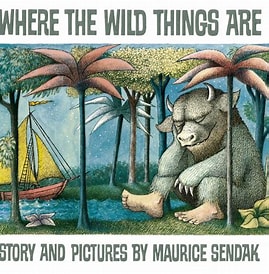
Where the Wild Things Are
A Teacher's Perspective on a Timeless Classic
Reviewer: Andrea Saladin 
A review of Where the Wild Things Are, by Maureen Sendak (2000), Random House, UK. ISBN: 9780099408390.
This book review will reintroduce the classic children's book Where the Wild Things Are by Maurice Sendak from a new perspective. Over sixty years after being awarded the Caldecott Medal for the Most Distinguished Picture Book of the Year 1964, this review discusses the book through the lens of an early childhood education teacher who understands the importance of helping young children learn about feelings.
Written and illustrated by Maurice Sendak, Where the Wild Things Are takes the readers, both old and young, on an adventure with Max, the energetic protagonist with a rich imagination.
Unimpressed by her son's boisterous play, Max's mother sends him to bed without dinner. Alone in his room, Max is not ready to settle down for the day. Instead of going to bed, Max follows his playful urges and dives into an imaginary world where adventure awaits him, and mischief is welcome. Max's journey to “Where the Wild Things Are" takes him on a rollercoaster of emotions over days, weeks and even years. But how much adventure can one energetic boy handle before hunger finally takes him back to reality?
From the simple setting that gives a glimpse of Max's ordinary home and life typical of his time, to the busy forests where the Wild Things live, each page is enriched with a detailed illustration and accompanied by simple, but playful language. Through this combination of playful language and vivid illustrations, Sendak has created a rich foundation from which the reader can take the audience and themself on an exciting journey. In fact, the illustrations are creative and vivid enough to be interpreted by children, so they can “read” the book without recognising or reading the text. For adult readers, however, Sendak provides prompts to bring the book to life, such as Max's monologue, which is written in capital letters: "BE STILL!". Ultimately, it is the reader who has the power to go on an adventure with Max and take their audience with them.
In an early education setting, this is a wonderful book for shared reading with the potential to target specific learning outcomes with intention. The rich illustrations create the foundation to actively engage children in the reading experience. Where the Wild Things Are can support oral language learning by introducing rich vocabulary through describing the illustrations, by asking open-ended questions and remembering to give children plenty of time to respond. The creative story can support dispositions, including but not limited to curiosity and creativity. What kind of imaginary world would your audience like to create?
The next time you pick up a copy of this book, however, I invite you to focus on the book's characters, more specifically, their facial expressions. From scared to angry, from happy to sad, the book illustrations can introduce young children to a range of emotions. With the intentional support of a teacher, the illustrations can support children's emotional learning, including the recognition and labelling of emotions. Emotion learning is an important part of social and emotional competence, which encompasses the ability to accurately recognise one’s own emotions and the emotions of others, the developing of situation knowledge to understand the causes of different emotions; and the appropriate use of emotions in social contexts to achieve desirable social outcomes; and is a predictor of holistic wellbeing and academic success (Ministry of Education, 2025; Sette, 2015).
Story time is ideal for creating meaningful opportunities to build emotional vocabulary development, to learn more about feelings and how we can express them. Therefore, when reading the story, convey the characters’ emotions; embellish the story with your own facial countenance and bring it to life with the expression in your voice. There is opportunity for dialogue too. The story, the illustrations and the time a teacher and child, or group of children, take to enjoy the book provide rich opportunities to talk about feelings, including how the characters might be feeling and why; if the children have ever felt that way; and what to do when someone else is feeling a big feeling, like feeling sad, angry or scared. These types of teaching moments might look like pausing during story time to ask, "How do you think Max is feeling right now?" or to reminisce about feelings “Remember how you felt when we jumped in the puddles yesterday?” Teaching could also involve encouraging children to make the same facial expression as the characters or having fun exploring the different ways we can express our feelings.
In summary, Where the Wild Things Are is a short read that can be enjoyed simply as an entertaining story, but with intentional pedagogy, kaiako can use this beloved book to foster children's learning about emotions. Through thoughtful discussion, the story becomes a powerful tool for helping children understand and express their feelings. If you are not familiar with this book, I urge you to find a copy. Most likely, however, you have read Where the Wild Things Are a gazillion times, and hopefully, like me, you still find joy in doing so and share your enjoyment with your audience.
References
Ministry of Education. (2025). Kōwhiti whakapae: Supporting teachers to assess and share children's early learning progress. https://kowhiti-whakapae.education.govt.nz/
Sendak, M. (2000). Where the wild things are. Random House, UK. ISBN: 9780099408390.
Sette, S., Bassett, H. H., Baumgartner, E., & Denham, S. A. (2015). Structure and validity of Affect Knowledge Test (AKT) in a sample of Italian preschoolers. The Journal of Genetic Psychology, 176(5), 330-347.
Author Profile
Andrea Saladin, Massey University
Andrea Saladin is an early childhood education teacher and currently completing a Master of Education (Early Years) at Massey University. Her Master's research focuses on fostering children’s emotion knowledge through a tiered storybook reading intervention and on whānau–kaiako collaboration and relationships. Inspired by the Tūāpapa o he Pikorua model, Andrea’s Master's research introduced a storybook reading intervention that is responsive to the individual needs of children and includes a range of reading strategies, including shared reading, dialogic reading and social story reading, with the aim of creating equitable learning opportunities