Why and how to integrate music into the early childhood classroom
Hamidreza Niknampour  and Birce Tanriguden
Music integration in early childhood education fosters holistic development, enhancing physical, cognitive, and social-emotional skills. This research note explores practical strategies for incorporating music into daily classroom routines, regardless of educators' musical expertise. Emphasising the developmental benefits of music, this article outlines methods to support physical coordination, cognitive growth, and social-emotional well-being through singing, movement, instrument play, and creative composition. Practical examples illustrate how educators can facilitate music-based activities that are accessible, inclusive, and engaging. By embedding music into classroom culture, educators can promote not only musical skills but also essential life skills such as cooperation, self-regulation, and creative expression. The discussion draws on contemporary research and pedagogical theories to support the integration of music as a foundational tool for young learners' development.
Why integrate music: The developmental power of music
Music is an essential component of early childhood education, playing a fundamental role in cognitive, social-emotional, and physical development (Särkämö et al., 2013). Early childhood educators, regardless of their musical background, may integrate music into their classrooms to create engaging, developmentally appropriate learning experiences to support the development of their students (Barret et al., 2019). This article provides research-based strategies and practical guidance on why and how educators may effectively use music and incorporate it into daily routines to foster young children's holistic development and honour their identities and backgrounds. Beyond its developmental benefits, music serves a vital cultural and relational function in the early years (Bond, 2017).
Physical development
Young children’s physical development typically progresses from large to small muscle control. Their ability to engage in musical activities such as playing instruments and moving rhythmically is directly connected to their motor development. For example, toddlers can shake tambourines or clap along to rhythms, while preschoolers may engage in more controlled actions like drumming to a steady beat (Bredekamp, 2021).
To support this development, educators may provide daily opportunities for movement-based musical play, adapt instruments to match children’s fine and gross motor skills, encourage body percussion (e.g., clapping, stomping, patting), and include activities that build coordination, such as jumping or balancing to a rhythm (Campbell & Scott-Kassner, 2013). Percussion instruments like shakers, rhythm sticks, and drums are particularly appropriate for young children, supporting hand-eye coordination and rhythmic awareness. A simple but effective activity involves educators playing a short rhythmic pattern for children to echo, which builds both motor control and aural discrimination, which is the ability to hear and distinguish between different sounds, pitches, or rhythms.
Cognitive development
Music also plays a vital role in cognitive growth. According to Piaget’s theory, children transition from sensorimotor exploration to symbolic thinking, which involves moving from learning through physical movement and sensory input to using symbols like words, images, or musical sounds to represent ideas. Music fosters this development by promoting pattern recognition, memory, and problem-solving skills (Jaschke et al., 2013). From a sociocultural perspective, children’s cognitive development is shaped through interaction with more knowledgeable others within meaningful cultural contexts, making music a powerful medium for co-constructing knowledge, language, and identity in early learning environments. Structured musical activities such as call-and-response songs, chanting rhymes, and rhythmic patterns help children develop classification abilities and spatial awareness (Bredekamp, 2021; Särkämö et al., 2013). In particular, music enhances phonological awareness, a critical foundation for literacy.
Phonological awareness refers to the ability to recognise and manipulate the sound structures of language, such as rhymes, syllables, and phonemes. Songs with repetitive lyrics, rhythmic syllables, and rhyming lines help children segment and decode words. Anvari et al. (2002) found that 4- and 5-year-old children with stronger musical skills also tended to have better early reading and sound awareness. Lamb and Gregory (2006) also found that children who were better at hearing pitch changes were more successful at early reading tasks, especially when identifying beginning sounds in words.
According to Brady (2020), phonological awareness can begin developing in preschool through songs that include rhyme, repetition, and rhythm, which help children segment spoken words into sound parts, a necessary skill for phonemic awareness and decoding. Additionally, Masters et al. (2023) highlighted how playful learning experiences that incorporate music can enhance vocabulary acquisition. Their toolbox of active, engaging, meaningful, and socially interactive strategies align with Feierabend’s (2006) First Steps of Music Curriculum activities, Songtales and Arioso (child created tunes), which use storytelling and improvisation to develop language, memory, and symbolic thinking.
Social-emotional development and well-being
Music-making significantly contributes to social-emotional development, offering a powerful context for emotional expression, social interaction, and identity formation (Váradi, 2022). Participating in music, especially in group settings, allows children to experience a sense of belonging and community. Activities such as group singing, movement games, and instrument ensembles help children practice cooperation, turn-taking, listening, and shared attention. These skills are foundational for empathy, social regulation, and mutual respect. Music also serves as a safe and accessible outlet for emotional expression. Through changes in tempo, volume, and mode, children may explore a range of emotions from excitement to calm. For example, drumming or body percussion may help children express big emotions or release excess energy, while slower melodies may soothe or help with transitions.
Importantly, musical improvisation and performance give children a chance to take creative risks, build confidence, and experience a sense of achievement. These moments nurture self-efficacy and emotional resilience, especially when children see their contributions recognised and celebrated.
Supporting cultural connections
Integrating music from diverse cultural traditions can create meaningful connections between classroom learning and children’s home lives. By incorporating multilingual lyrics, culturally diverse instruments (e.g., djembes, guiros, sitars), and musical games from various communities, educators affirm students’ identities and promote an inclusive learning environment. These approaches not only create cultural awareness but also strengthen children’s sense of belonging and identity development (Bond, 2017). Researchers have shown that musical engagement plays a central role in how children navigate and express their cultural identities. Ripani (2022) found that children actively shape their musical identities through interactions with their cultural and social surroundings. Adorno (2025) similarly highlighted how music enables second-generation immigrant children to negotiate values, traditions, and belonging. Building on this, Howard (2018) demonstrated that music curricula grounded in culturally specific practices support not just musical development, but also social understanding and multicultural sensitivity.
How to integrate music: Practical strategies
Many educators feel uncertain about their musical abilities. However, small steps like using familiar songs, collaborating with peers, or setting weekly musical goals can boost confidence (de Vries, 2014). Supportive environments where educators co-plan or co-lead musical activities also build comfort over time. Encouraging educators to celebrate small wins and reflect on student responses can further reinforce positive teaching experiences.
Singing and vocal exploration
Singing is one of the most accessible musical tools for young learners. It enhances language development, pitch recognition, and social cohesion (Bredekamp, 2021). Early childhood educators may integrate name songs, greeting songs, and transition songs to reinforce routines, encourage pitch exploration through vocal play (e.g., animal noises, sirens), and provide opportunities for both solo and group singing to build confidence and social cohesion (Campbell & Scott-Kassner, 2013). For singing, educators may use:
- Name songs and greeting songs to build community
- Echo songs to develop listening and pitch-matching
- Transition songs to ease children between activities
- Nursery rhymes and folk songs to reinforce rhythm and rhyme
Vocal exploration through animal sounds, pitch slides, or siren sounds encourages children to experiment with their voices. Songs with a limited vocal range (C4–G5) are best suited for young children’s developing voices. Solo singing opportunities (e.g., answering questions in a song) may also help boost confidence.
Movement and dance integration
Movement deepens children’s musical understanding while building gross motor coordination and self-regulation. Educators may incorporate Laban Movement Themes (e.g., heavy/light, fast/slow, bound/free) to help children explore dynamic movement qualities and connect with music on a kinesthetic level (Duncan, 2015). By using a diverse repertoire of recorded music, educators may encourage movement that reflects mood, tempo, and dynamics. Activities might include:
- Movement games tied to song lyrics (e.g., If you’re happy and you know it)
- Creative movement sessions where children interpret music with their bodies
- Dance routines that follow a repeated structure, supporting memory and sequencing (e.g., Folk dances)
Instrument exploration and play
Exploring instruments develops both fine motor control and auditory discrimination. Instruments such as drums, maracas, xylophones, and Orff instruments, which are child-friendly percussion tools like glockenspiels and xylophones designed to support exploration and improvisation, are ideal for early learners. Educators may begin with non-pitched percussion before introducing melodic instruments. Activities might include:
- Echo drumming or clapping patterns
- Group improvisation to explore different timbres
- Guided ensembles play to practise rhythmic accuracy and turn-taking
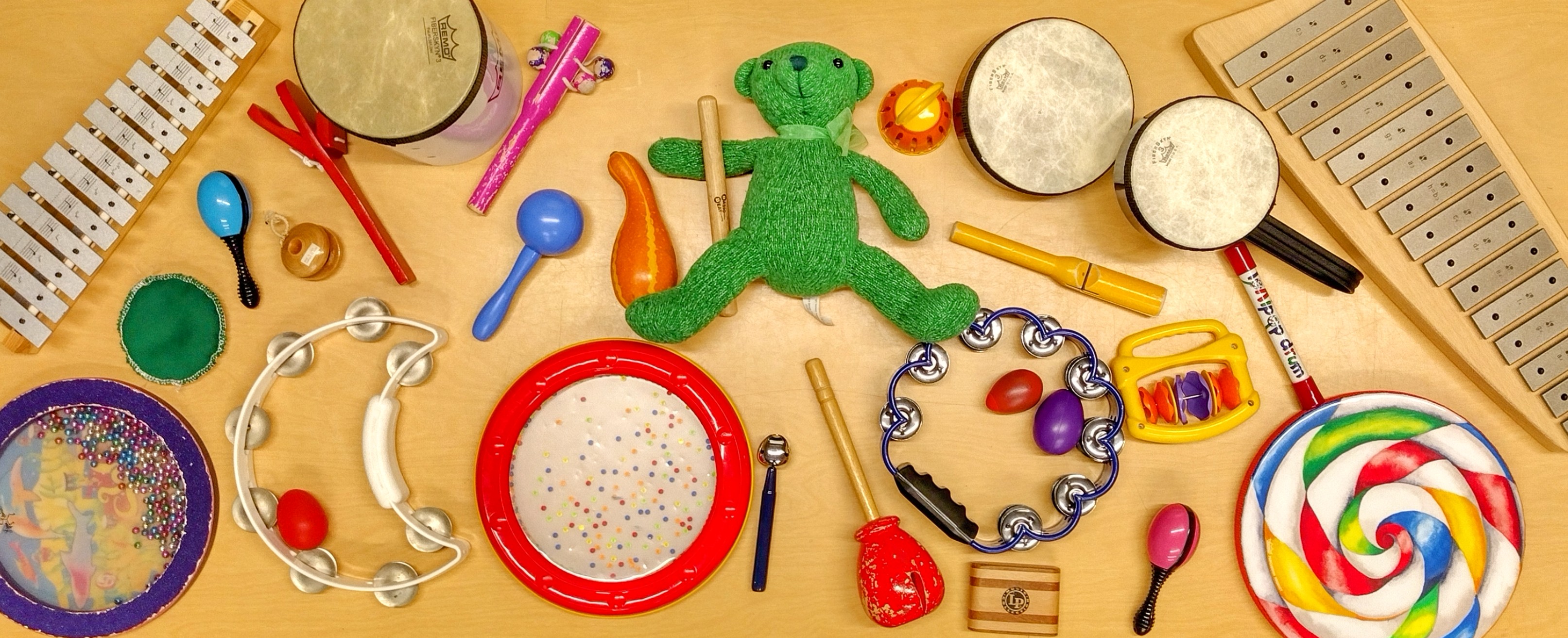
Orff instruments
Listening and musical awareness
Listening activities help children build aural skills, focus, and musical vocabulary. Exposure to varied genres (e.g., classical, jazz, folk music) enhances musical appreciation and supports cultural responsiveness. Strategies include:
- Using stories or puppets to illustrate musical change
- Playing “guess the instrument” games to develop timbre recognition
- Using listening maps to follow musical form
- Reflecting on how a piece of music feels and why
Spontaneous music-making during free play is equally valuable. Educators can encourage children to explore sound naturally by banging pots, humming their own tunes, or creating dances to imaginary music. Providing access to open-ended materials (scarves, homemade instruments) in play areas can support child-led musical exploration. Observing and responding to these moments can affirm children's creativity and leadership.
Creative composition and improvisation
Encouraging children to make their own music fosters self-expression, confidence, and a deeper understanding of musical structure. Educators may:
- Use graphic notation or picture symbols to represent sounds
- Invite children to invent lyrics to familiar melodies
- Offer everyday objects for sound exploration
- Help children layer sounds to create musical textures
Additionally, educators may guide children in layering sounds to create musical textures by starting with a steady beat and gradually adding other sounds, and extend this into story-based composition, where children use instruments or objects to create sound effects that accompany a shared narrative, encouraging collaborative creativity and compositional thinking.
Implementing a music-rich culturally responsive curriculum
A truly music-integrated classroom requires more than isolated activities. It means embedding music into the fabric of classroom life:
- Create a music-friendly environment with accessible instruments, listening centres, and musical visuals
- Establish daily routines: a welcome song in the morning, a tidy-up tune before transitions, and a line-up song
- Use adaptations for inclusion: simplified movements, adapted instruments for students with special needs, or visual supports
- Involve families and communities: invite guest musicians, ask families to share songs from their cultures, and record classroom songs to send home for continued engagement
- Use age-appropriate circle games and folk dances drawn from the children’s cultures to embed cultural knowledge into joyful group movement and musical play
- Run family song projects, encouraging children to learn and share lullabies, nursery rhymes, or folk songs from family members, bringing home traditions into the classroom
- Design music centres that include instruments, stories, and sound materials from a range of traditions, especially those represented in the classroom, to create curiosity in diverse cultural expressions
Conclusion
Music is far more than a supplementary subject; it is a foundational tool for whole-child development. When used intentionally, music enhances young children’s physical coordination, cognitive skills, and emotional and social growth. By integrating singing, movement, listening, instrument play, and creative composition into daily routines, early childhood educators may foster lifelong musical engagement and developmental readiness in their students.
References
Adorno, S. S. (2025). Navigating identities: The musical lives of four second-generation immigrant children.Journal of Research in Music Education, 73(1), 109-132. https://doi.org/10.1177/00224294241256929
Anvari, S. H., Trainor, L. J., Woodside, J., & Levy, B. A. (2002). Relations among musical skills, phonological processing, and early reading ability in preschool children.Journal of Experimental Child Psychology, 83(2), 111-130. https://doi.org/10.1177/00224294241256929
Barrett, M. S., Flynn, L. M., Brown, J. E., & Welch, G. F. (2019). Beliefs and values about music in early childhood education and care: Perspectives from practitioners. Frontiers in Psychology, 10, 724. https://doi.org/10.3389/fpsyg.2019.00724
Bond, V. L. (2017). Culturally responsive education in music education: A literature review. Contributions to Music Education, 42,153–180. https://www.jstor.org/stable/26367441
Brady, S. (2020). A 2020 perspective on research findings on alphabetics (phoneme awareness and phonics): Implications for instruction (Expanded Version). The Reading League. https://www.thereadingleague.org/wp-content/uploads/2020/10/Brady-Expanded-Version-of-Alphabetics-TRLJ.pdf
Bredekamp, S. (Ed.). (2021). Developmentally appropriate practice in early childhood programs serving children from birth through age 8 (4th ed.). National Association for the Education of Young Children.
Campbell, P. S., & Scott-Kassner, C. (2013). Music in childhood: From preschool through the elementary grades (4th ed.). Schirmer.
de Vries, P. A. (2014). Music without a music specialist: A primary school story. International Journal of Music Education, 33(2), 210-221. https://doi.org/10.1177/0255761413515818
Duncan, S. (2015). Early childhood education and dance: Laban movement analysis to develop pedagogy. Dance Undergraduate Thesis. https://core.ac.uk/download/pdf/519831616.pdf
Feierabend, J. M. (2006). First steps in music: The teacher’s guide. GIA Publications.
Howard, K. (2018). The emergence of children’s multicultural sensitivity: An elementary school music culture project. Journal of Research in Music Education, 66(3), 261–277. https://doi.org/10.1177/0022429418784594
Jaschke, A. C., Eggermont, L. H., Honing, H., & Scherder, E. J. (2013). Music education and its effect on intellectual abilities in children: A systematic review. Reviews in the Neurosciences, 24(6), 665–675.
Lamb, S. J., & Gregory, A. H. (2006). The relationship between music and reading in beginning readers. Educational Psychology, 13(1), https://doi.org/10.1080/0144341930130103
Masters, A. S., Scott, M. E., Wright, C. A., Toub, T. S., Dickinson, D. K., Golinkoff, R. M., & Hirsh-Pasek, K. (2023). Playing with words: Using playful learning experiences in the early childhood classroom to build vocabulary. Reading Teacher, 76(6), 775–783.
Ripani, G. (2022). Children’s representations of music, musical identities, and musical engagement: Content and socio-demographic influences. Journal of Research in Music Education, 70(3), 271–296. https://doi.org/10.1177/00224294211065096
Särkämö, T., Tervaniemi, M., & Huotilainen, M. (2013). Music perception and cognition: Development, neural basis, and rehabilitative use of music. WIREs Cognitive Science, 4(4), 441–451. https://doi.org/10.1002/wcs.1237
Váradi, J. (2022). A review of the literature on the relationship of music education to the development of socio-emotional learning. Sage Open, 12(1). https://doi.org/10.1177/21582440211068501
Author Profile
Hamidreza Niknampoour, University of Hartford,
Hamidreza Niknampour, born in Iran in 1994, holds a bachelor's degree in Applied Chemistry from Isfahan University of Technology and a Master's in Classical Guitar Performance from the University of Tehran. He is a Ph.D. candidate in Music Education at the University of Hartford, focusing on music engagement in elementary students. His research explores the intersection of music and psychology, including studies on piano learning and executive functioning. Hamid has published peer-reviewed articles on generalized anxiety disorder in music students and has nearly a decade of teaching experience. He also performs classical guitar in solo and ensemble settings.
Email: niknampou@hartford.edu
Dr. Birce Tanriguden, University of Hartford
Dr. Birce Tanriguden is a music educator and researcher with nearly 20 years of experience in K–12 and higher education. She teaches music education at the University of Hartford’s Hartt School, focusing on teacher education, teaching methods, and curriculum development. Dr. Tanriguden has published in journals like Women in Higher Education and Inside Higher Ed and regularly presents at national and state music education conferences. She contributes to curriculum development in both music and theatre divisions, sharing research and practical insights to support future music educators.
Editor's note
Inspired by Hamidreza Niknampour and Birce Tanriguden’s research note, our EEJ team would love to hear from teachers who are creating music-rich environments in their early years education settings. Whether you have an innovative approach, a success story, or insights from your own teacher inquiry, we invite you to share your experiences by submitting to Early Education Journal.
For teachers in Aotearoa New Zealand, integrating waiata and recitations from te Ao Māori can foster important learning opportunities for children and communities. When children are immersed in cultural practices—hearing early morning waiata, oriori, mōteatea, and karakia, along with traditional recitations during daily transitions like waking and sleeping—they develop deep connections to whakapapa and a strong sense of belonging. These musical experiences establish children's roles within their community and strengthen their sense of identity (Rameka et al., 2017).
Rameka, L., Glasgow, A., Howarth, P., Rikihana, T., Wills, C., Mansell, T., Burgess, F., Fiti, S., Kauraka, B., & Iosefo, R. (2017). Te whātu kete mātauranga: Weaving Māori and Pasifika infant and toddler theory and practice in early childhood education. TLRI. https://tlri.org.nz/research/category/early-childhood/