Introducing New Zealand Sign Language within and inquiry-based assessment
Paige Thomson and Gillian Postlewaight 
New Zealand Sign Language (NZSL) promotes inclusive and equitable learning by supporting communication for all tamariki. Embedding NZSL within early childhood education aligns with the Teaching Council's Standards for the Teaching Profession, and fosters inclusive practices and responsive pedagogy. The research note shares practical strategies to integrate NZSL into daily routines and play, in natural and meaningful ways, and highlights the value of authentic learning opportunities that foster engagement, contribution and a sense of belonging in early childhood settings.
Introduction
New Zealand Sign Language (NZSL) has evolved to align with both English and Māori languages, and is recognised as an official language of Aotearoa New Zealand. Similar to other sign languages, NZSL involves a distinctive vocabulary, multiple linguistic elements, visual characters, gestures and styles (Deaf Aotearoa, n.d.) NZSL is an effective pedagogical teacher practice that encourages inclusive, culturally responsive, and equitable learning. It supports all learners, particularly those with varying communication needs, and reflects dedication to intentional, reflective, and child-centred teaching (Ministry of Education, 2017).
Understanding NZSL supports kaiako to remove language barriers that could hinder the learning and development of tamariki (Ministry of Education, 2019). Tamariki who are part of the deaf community and have communication barriers can be excluded in ECE when kaiako lack knowledge of NZSL. This disregards the true intent of Te Whāriki (Ministry of Education, 2017), which emphasises the responsibility of kaiako to ensure they provide an inclusive environment for all tamariki regardless of gender, age, learning diversity and/or abilities. Sign language is an authentic pedagogical practice that upholds and values The Teaching Council Standards (NZTC, 2017), particularly in areas of design for learning, teaching, professional learning, learning-focused culture, and professional relationships.
This research note examines my experiences and perspectives when introducing NZSL as a tool to support tamariki transitioning from an infant and toddler space to a busy and larger young children's environment. Using an inquiry-based method, the descriptions, information and reflections focus on the approaches and strategies used to respond to children's communication needs, and the outcomes from these experiences. I chose this focus for an assessment in the third year of my Initial Teacher Education. This assessment required me to undertake a co-operative approach to instigate a change to practice, working collaboratively with tamariki, whānau and the teaching team. The assessment was titled 'The Culminative Integrating Assessment' (CIA).
What is the Culminative Integrating Assessment (CIA)?
The Teaching Council Aotearoa New Zealand (NZTC, 2017), requires students in Initial Teacher Education (ITE) programmes to engage in, build a strong understanding of, and have the ability to demonstrate all six of the Standards for the Teaching Profession confidently across the three years of the programme. This entails demonstration through assessment.
The Eastern Institute of Technology's approach to the CIA encouraged us to identify an aspect/s in an authentic practice situation within our practicum placement that requires complex decision-making. For this assessment, we were required to draw on multiple sources of information and integrate knowledge and skills that relate to more than one standard. Our authentic practice situation needed to reflect complexity and diversity, and to consider theory, teaching practices, and outcomes for tamariki. We explored and discussed different approaches across different aspects of our practice.
As part of the assessment, I gathered evidence and research into how NZSL was used in daily routines, rituals, and play in my PEP centre, to help me feel confident to trial NZSL in my field-based centre. The PEP centre nursery displayed a range of NZSL posters and books, accessible for tamariki, whānau, and with resources available for whānau to take home. These strategies supported tamariki to understand basic NZSL vocabulary. Kaiako and tamariki collaboratively practised the use of basic NZSL alongside verbal communication. This dual approach is important because tamariki learn from what they see and hear. Using spoken words while signing, supports tamariki to connect movement and sign with meaning (Simpson & Lynch, 2007). Reflecting on these approaches with kaiako supported my understanding of the importance of kaiako providing tamariki with both non-verbal and verbal communication opportunities. Kaiako have a critical role in supporting tamariki in their communication development, as it is through responsive interactions that tamariki pick up language and gestures that they have heard or seen (White, 2019).
Implementation of NZSL at my field-based centre
At my field-based centre (where I worked part-time each week), I worked with tamariki aged 2-5 years. Over a two-week period, I introduced six different NZSL phrases during mat time. In the first week, the words, please, thank you, and all done were shared, and during the second week, kai, water, and more were introduced. On my first day of implementing, I read a book that contained six NZSL phrases and provided the tamariki with an overview of why it is important for them to use and understand how to sign. I used the book as a guide to support the tamariki while showing them the different signs we practised. I placed photo frames of the six phrases by the kai table as visual prompts for tamariki, kaiako and whānau to engage with. At each mat time, I revisited what tamariki had learnt the day before and encouraged them to demonstrate the NZSL word or phrase.
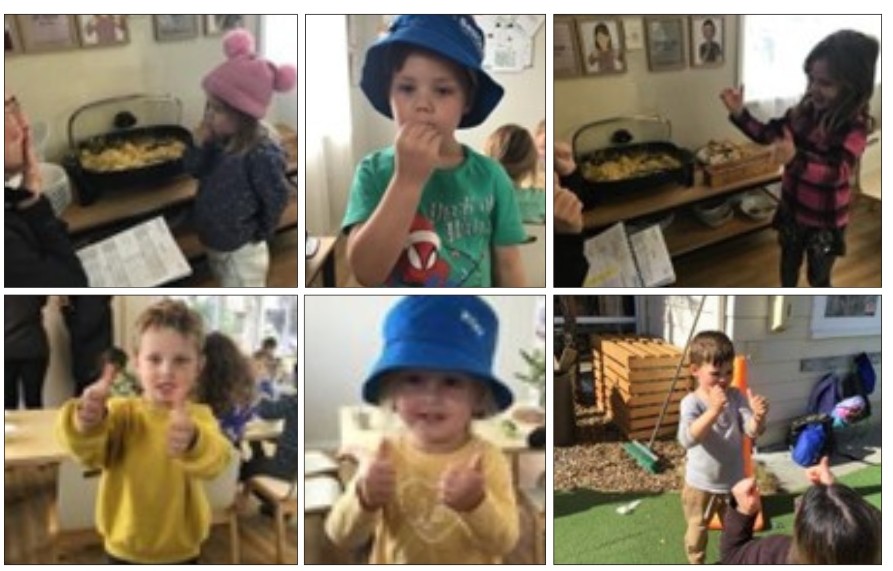
Outcomes for tamariki
Tamariki confidently used NZSL when communicating please and thank you, asking for kai or more, and saying all done. During mat times, I offered tamariki the opportunity to stand up and show their peers what they had remembered and learnt from previous days, if they were comfortable doing so.
This approach combined explicit teaching with opportunities for peer learning, fostering confidence and engagement. To support learning, I used a wide range of teaching techniques such as demonstrating, encouragement and praise, empowerment, reinforcing, and scaffolding (MacNaughton & Williams, 2009). For example, during kai times, I extended learning by encouraging tamariki to practise the different signs they remembered. I would demonstrate or model signs if tamariki were having trouble remembering. I would converse with tamariki to see if they were able to build on the knowledge they had learnt. My approach also provided the opportunity for tuakana–teina relationships between the older and younger tamariki, as the older tamariki would often support their younger peers when practising the different signs.
The impact of these strategies was evident. NZSL is now embedded into the centre's routine, rituals, and curriculum as tamariki build on new and prior learning, with a positive impact on learning for all tamariki. This was seen when the tamariki were practising not only the different signs we had learnt during the day and at kai routines but also coming to me and asking to learn more signs. This demonstrated growing agency and enthusiasm for communication.
Key to my teaching approach was creating a safe and trusting environment where the tamariki were confident in practising their learning amongst their peers, providing them with appropriate support in learning and understanding a new form of communication. This is seen through utilising mat time as a way of introducing basic NZSL that relates to routines that the tamariki are familiar with. These teaching strategies uphold the NZTC (2017) teaching standard of Design for Learning, since they are based around my knowledge and understanding of how I can ensure all tamariki are involved while making it engaging for them (Subasinghe, 2018). Design for Learning emphasises the importance of kaiako having pedagogical knowledge that enables us to understand the way tamariki learn in order to provide meaningful learning experiences and opportunities. My approach also reflects the standard of Teaching and Learning-Focused Culture, as I planned and implemented practices that promoted a positive environment, peer collaboration, and shared responsibility for learning (Ministry of Education, 2013).
Extension to whānau engagement and professional relationships
The conversation (below) between myself and a parent, demonstrates the positive engagement the implementation has had for their child. The learning has been reflected in their home environment and the confidence to teach and guide their whānau is highly visible.
Parent: "Omg Paige, I had to tell you, M came home and started using sign, and when we asked where he learnt it, he said you have been teaching it to the children. That is so awesome, I love it!"
Me: "That’s so cool, yeah, I had to implement something I found interesting from my five-week practicum, and I thought introducing sign would be really beneficial for the children’s language and communication.”
Parent: “Yeah, totally. Is there any way you could share what you are teaching them with the whānau so we can practise with them and learn ourselves?”
Me: “Yup, I will share photos of the ones we are learning on Story Park!”
This conversation led to further engagement, with whānau requesting resources so they could practise signs at home. Sharing photos of the signs on Storypark extended learning beyond the centre, enabling tamariki to teach their families and strengthening home-centre partnerships. (Storypark is an online platform that supports communication between teachers and whānau). These interactions reinforced the value of creating inclusive, collaborative relationships that support tamariki learning across contexts.
Feedback from whānau also affirmed the approach provided a safe, engaging environment where tamariki felt confident to share their learning. Parents noted increased confidence and enthusiasm in their children, and appreciated the use of visual resources to support different learning styles. This responsiveness to tamariki and whānau reflects my commitment to enhance learning through knowing their individual strengths, interests and needs.
Reflecting on these outcomes deepened my understanding of how intentional teaching strategies, such as modelling, scaffolding, and fostering tuakana–teina relationships, can empower tamariki and strengthen partnerships with whānau. It also highlighted the importance of professional collaboration, as working alongside kaiako and whānau created a shared sense of purpose in supporting communication and learning.
Conclusion
Introducing NZSL had a clear and positive impact on children’s learning. Tamariki demonstrated strong enthusiasm for acquiring new signs, actively practising them throughout the day and engaging more confidently during mat times. This experience supported their communication skills, strengthened peer interactions, and encouraged greater agency in their own learning. Providing access to NZSL also deepened children’s awareness of diverse communication methods used within their wider community. Almost a year on from this experience, the children still show strong interest and confidence in using the signs they learnt, as well as being willing to learn new ones alongside their peers and kaiako.
Completing the CIA further enhanced my professional practice by reinforcing the value of multimodal communication in early childhood education. It challenged my thinking and practice to ensure I was effectively planning how to implement this new learning into my centre, in ways that upheld our philosophy and vision, as well as the children's learning and preferred learning approaches. Overall, the introduction of NZSL, supported by the insights gained from the CIA, strengthened my confidence as a kaiako and affirmed the importance of adaptable, responsive practices that promote the learning and development of all tamariki. I am grateful for this experience as it has strengthened and enhanced my confidence and agency in comfortably implementing new practices and documentation.
References
Deaf Aotearoa (n.d.). https://www.deaf.org.nz/resource/fact-sheet-new-zealand-sign-language/
Education Council New Zealand–Matatū Aotearoa. (2017). Our code our standards: Code of professional responsibility and standards for the teaching profession: Ngā tikanga matatikangā paerewa: Ngā tikanga matatika mō te haepapa ngaiotanga me ngā paerewa mō te umanga whakaakoranga.
MacNaughton, G., & Williams, G. (2009). Techniques for teaching young children: Choices for theory and practice. Pearson Prentice Hall.
Ministry of Education–Te Tāhuhu o te Mātauranga. (2020). Talking together: Te kōrerorero.
Ministry of Education–Te Tāhuhu o te Mātauranga. (2019). He māpuna te tamaiti: Supporting social and emotional competence in early learning: Ngā pūkenga whakaratarata me te whakapakari whatumanawa i ngā akoranga kōhungahunga.
Ministry of Education–Te Tāhuhu o te Mātauranga. (2017). Te whāriki: He whāriki mātauranga mō ngā mokopuna o Aotearoa: Early childhood curriculum.
Ministry of Education–Te Tāhuhu o te Mātauranga. (2013). Ka Hikitia Accelerating Success 2013–2017. The Māori Education Strategy. https://www.education.govt.nz/assets/Documents/Ministry/Strategies-and-policies/Ka- Hikitia/KaHikitiaAcceleratingSuccessEnglish.pdf
Simpson, C. G., & Lynch, S. A. (2007). Sign language: Meeting diverse needs in the classroom. Exchange Press, 176, 45. https://hub.exchangepress.com
Subasinghe, P. (2018). Creating a culturally safe learning environment for young children in institutionalised childcare (a personal reflection on current practice). He Kupu, 5 (4), 29–35b. https://www.hekupu.ac.nz/article/creating-culturally-safe-learning-environment-young-children-institutionalised-childcare
White, A. (2019). Strategies for supporting children’s communication in educational settings. The Education Hub. https://theeducationhub.org.nz/strategies-for-supporting-childrens-communication-in- educational-settings/
Author Profile
Paige Thomson, Early Childhood Education Kaiako
Paige Thomson is a recently graduated student of the Bachelor of Teaching Early Childhood Education, presently completing her first year as a full-time teacher. The focus of this article is intentional teaching pedagogy, based on her culminating learning during her initial teacher education.
Email address: paige03.thomson@gmail.com
Gillian Postlewaight, Te Aho a Māui Eastern Institute of Technology
Gillian Postlewaight has been a teacher educator at EIT for 22 years. Her interests in research include student teacher agency, transition to school and most recently, place-based learning in ECE.